Three ores, one shared store and deposits that run dry. What you mine decides what you can build ten minutes from now.
The three ores
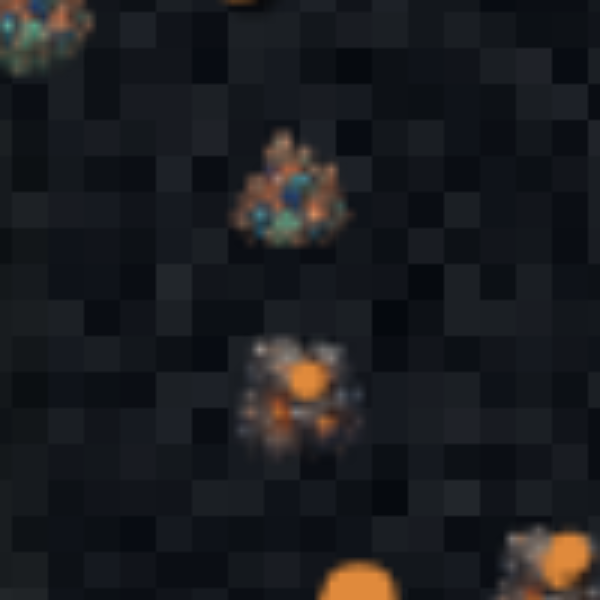
Iron carries the opening — more than half of all costs in the game are paid in iron, and some buildings cost iron alone. Copper and titanium arrive with the tech. Inside a harvester what counts is weight, not amount: a load of titanium fills it twice as fast as iron.








| Ore | Space in harvester | Starting stock |
|---|---|---|
| Iron | 1× | 340 |
| Copper | 1.33× | 130 |
| Titanium | 2× | 0 |
Ore is an area — and it runs dry
A deposit is not a point but a field of many small cells. A harvester clears the cell beneath it and then moves on — you can see on a field where it has already been worked and where ore is left. You click a SPOT, not a centre: right-click anywhere into the field and that is where mining happens. A harvester is assigned one ore type once and sticks to it, and it stays at its field until the field runs dry. So you steer your mix less by individual orders than by where you put your refineries: if ore is half as far away as the alternative, a new harvester takes the near one. Buildings must keep some distance from ore — otherwise you could wall a field in and keep it to yourself.
Where your harvesters come from
You start without a single harvester — every finished refinery brings one along. That is why the second refinery is part of almost every opening: it is drop-off and producer in one. The first three harvesters each get their own ore type so that none is neglected; after that the fleet spreads four iron to three copper to two titanium. Those are harvester shares, not tonnage shares: a titanium load weighs double, and a long route cuts the yield. Two harvesters always stay on titanium — without that clamp nobody mines the ore you need late and then need at once.
One store for everything
The three ores share ONE store. Once it is full the economy stalls — nothing is lost, but harvesters wait at the ore field with a full load instead of blocking the refinery dock. So that one kind cannot take over, part of the store is reserved for iron: copper and titanium together may fill at most 60 %. Without that rule you can reach a dead end with no way out — the silo that would enlarge the store costs iron itself. And losing a refinery or a silo also costs you whatever sits above the now smaller cap.
| Source | Storage |
|---|---|
| Command center | 500 |
| per refinery | + 800 |
| per silo | + 1000 |
| Copper + titanium together | 60 % of the store |
Two economic models
Steel Union, Scrap Legion and Aegis Order mine ore. Collective and Bloom do not: they convert everything into components and draw up to half their income from battlefield wrecks rather than the ground. In exchange they mine more slowly at the ore field. Playing against them, know that every unit you lose can become their supply — a foreign wreck is worth three quarters of its build cost, one of their own two fifths. Wrecks last five minutes and can be shot to pieces: area weapons are the counter to a salvage economy.


| Faction | Model | Mining rate | Price level |
|---|---|---|---|
| The Steel Union | Ore | 100 % | 100 % |
| The Scrap Legion | Ore | 100 % | 100 % |
| The Aegis Order | Ore | 100 % | 100 % |
| The Collective | Components + salvage | 75 % | 98 % |
| The Blight | Components + salvage | 75 % | 112 % |
| The Orbitals | Ore | 100 % | 100 % |